
The First Five Minutes Decide Who Wins the Customer
Why speed to lead is the ultimate competitive advantage, and how the businesses that reply first are winning the trust and the deals.
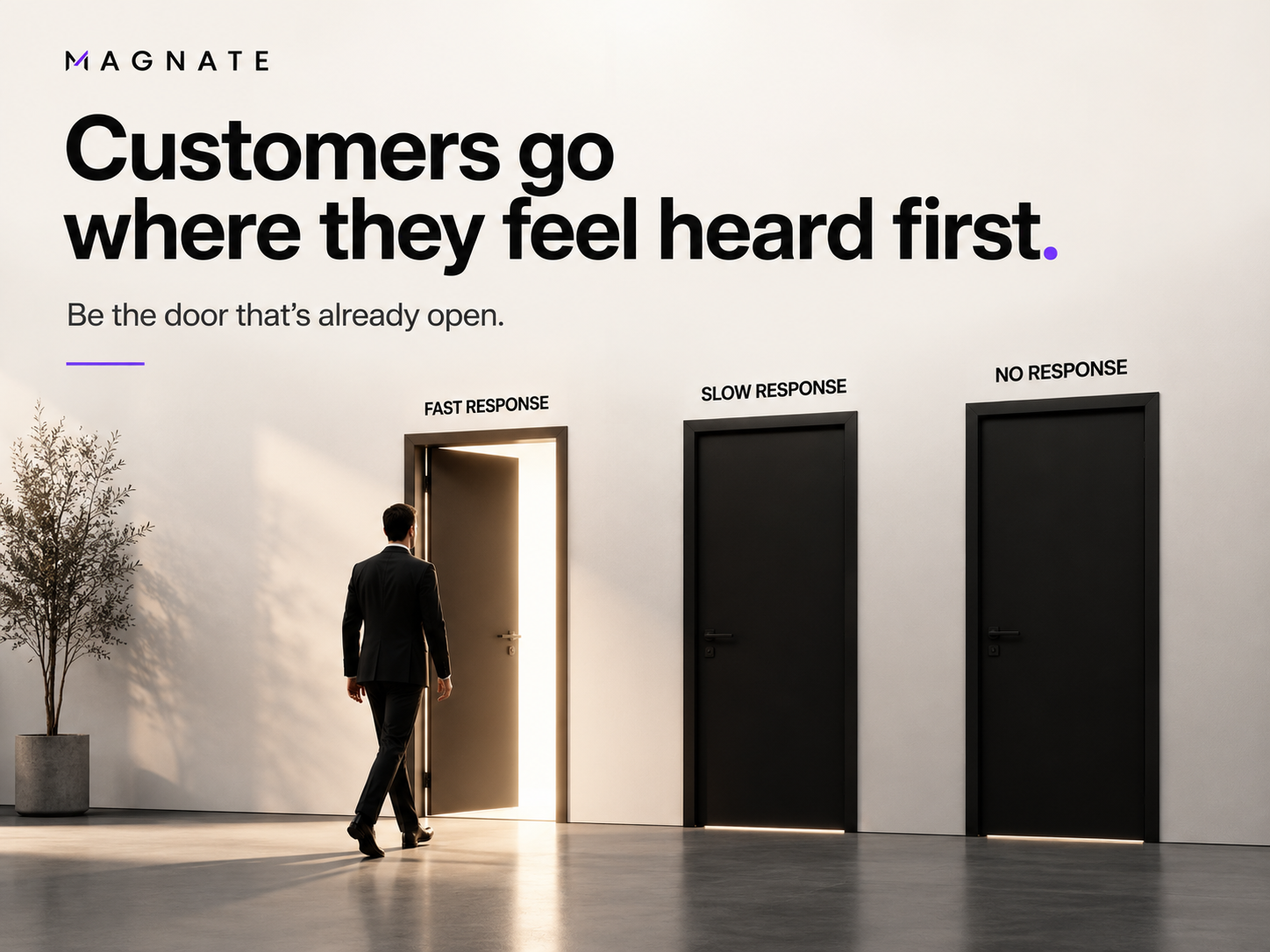
Put yourself in your buyer’s shoes for a moment. You have a pressing problem that needs solving today.
You open Google. You click on the top three search results and fill out a contact form on each website.
- Website A texts you back within 45 seconds, asking a clarifying question about your exact needs.
- Website B emails you automatically, but a human doesn't reply until after they finish their lunch break.
- Website C waits until tomorrow morning to give you a call.
Who do you do business with?
The answer is overwhelmingly, unequivocally Website A.
In modern sales, the vendor who replies first doesn't just get the first conversation they anchor the entire buying experience. They set the standard. By the time Website B and Website C finally reach out, you’ve already moved emotionally past the "shopping" phase and into the "buying" phase with Website A.
The Psychology of the 5-Minute Window
It’s easy to think of lead response time as a simple metric to track on a dashboard. But fundamentally, it’s about human psychology.
When a prospect reaches out to you, they are in a state of high intent. They have carved out a specific block of time in their busy day to solve this specific problem. For a brief, fleeting moment, you have their undivided attention.
Research surrounding Google's micro-moments and famous lead response studies all point to a staggering reality: if you reply within five minutes, your odds of qualifying that lead are exponentially higher than if you wait just 30 minutes.
It’s not just about speed; it’s about trust. When a business responds instantly, it implicitly signals to the buyer: We are organized. We care about your time. We are ready to handle your business. Conversely, silence breeds doubt. Every minute that ticks by without an answer tells the prospect that their inquiry isn't a priority.
Why Do Businesses Keep Customers Waiting?
If the data is so clear, why do the vast majority of businesses take hours sometimes days to respond to inbound interest?
The truth is, nobody wants to be slow. But legacy sales processes were built for a 9-to-5 world, not an on-demand economy. Look at the reality of a normal sales team:
- They are busy: Reps are tied up on discovery calls or writing proposals.
- They are human: They take lunch breaks. They step away for coffee. They get bogged down in internal meetings.
- The "After-Hours" Black Hole: A massive percentage of B2B research happens after 6:00 PM, on weekends, or during holidays. A lead that comes in on Friday night sits entirely untouched until Monday morning.
When you rely entirely on manual human effort to capture initial intent, delays aren't just possible sthey are structurally guaranteed.
What Customers Actually Expect
Here is where many businesses misunderstand the modern buyer: prospects don't expect an instant sale. They expect an instant answer.
When someone submits a form or sends a WhatsApp message, they aren't demanding that a Senior Account Executive drops everything to run a 60-minute demo right that second.
What they do demand is immediate acknowledgment. They want their specific questions answered. They want to know they've been heard, and they want to seamlessly book the next step without friction. They expect the digital equivalent of walking into a retail store and being greeted by a knowledgeable concierge immediately.
The Future Belongs to the First Responder
We have crossed a threshold where "good" customer service is no longer a differentiator it is the baseline.
In the near future, the businesses that thrive won't necessarily be the ones with the slickest marketing campaigns or the biggest ad budgets. They will be the ones that have built the infrastructure to capture intent the very second it happens.
If you want to win, you have to respond first. The companies that do will earn the right to compete for the business. The ones that don't won't even realize they were in the race.
How quickly does your team respond after hours?