
Why Business Owners Spend More Time Managing Software Than Growing Their Business
The proliferation of SaaS tools was supposed to make us productive. Instead, it created an endless cycle of context switching. Here is how the future of operations changes that.
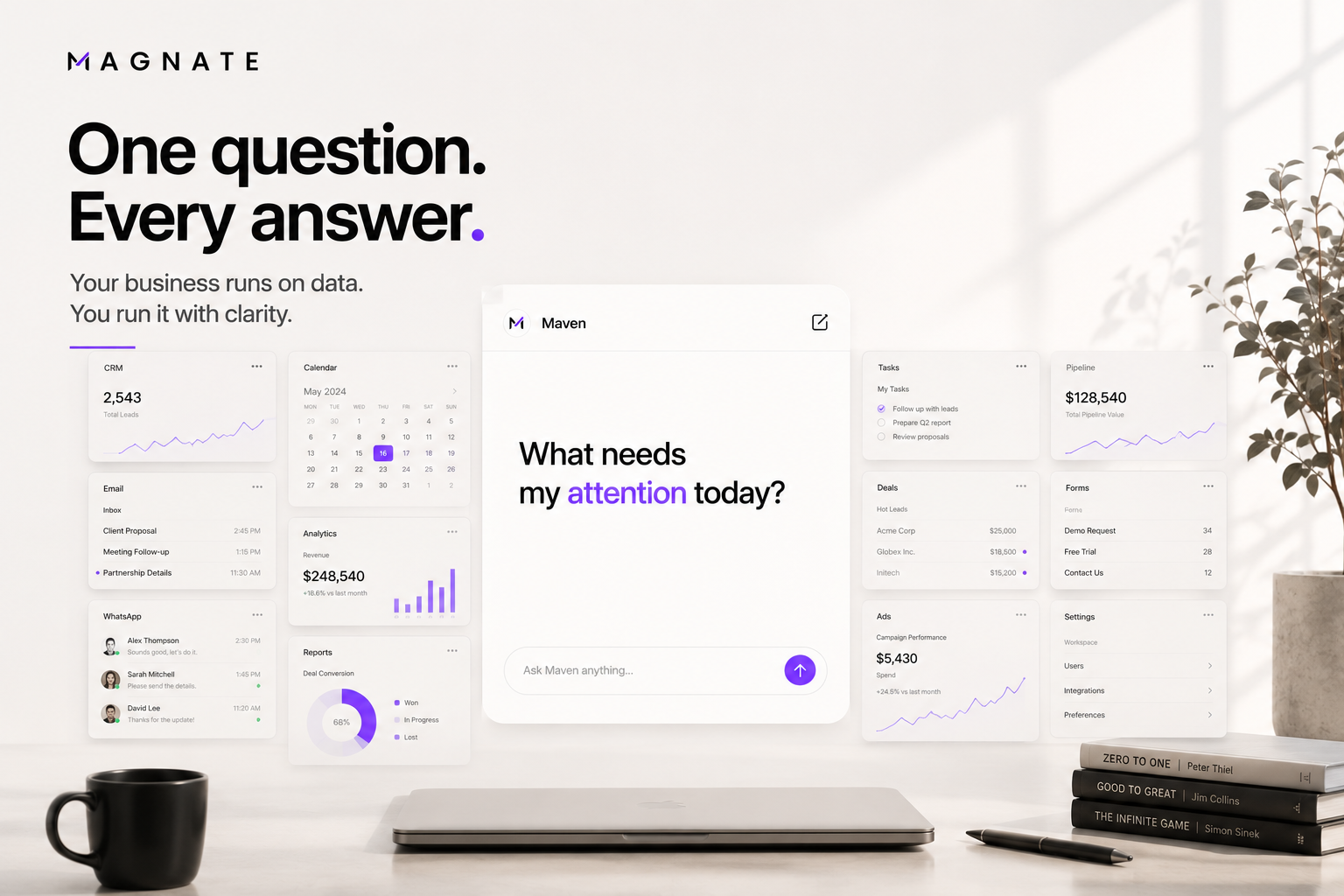
The average small business doesn't have one operating system.
It has fifteen.
You likely have one tab open for your CRM. Another for your Email. Then there is your Calendar. And your WhatsApp Web interface. Let's not forget your Analytics dashboard, your Marketing platform, your Apple Notes, and an endless sea of Google Spreadsheets.
Each of these software solutions was sold to you with a singular promise: productivity.
But together, they have created something else entirely: chronic context switching.
The Hidden Cost of the Modern Tech Stack
Business owners don't lose productive hours because they are lazy or disorganized. They lose hours because every single answer they need to run their business lives in a different place.
Think about a typical customer lifecycle:
- Their basic contact info is in the CRM.
- The actual context of their last conversation is buried in WhatsApp.
- The next step is tracked in Google Calendar.
- Their acquisition cost data is hidden inside Meta Ads.
- Their invoice is sitting in Stripe or QuickBooks.
The result of this fragmentation is paralyzing. You spend exponentially more time searching for the data than you do actually deciding what to do with it. You are acting as a human API, constantly ferrying information from one dashboard to another just to keep the lights on.
Software Solved Storage, Not Execution
If we look back at the last twenty years, the first generation of SaaS was revolutionary, but it fundamentally only did one thing: it digitized information. It took physical filing cabinets and put them in the cloud.
But a digital filing cabinet is still just a filing cabinet.
The next generation of software cannot just be about storage. It must be about execution. Modern business software shouldn't just passively remember where your leads are. It should actively know what needs to happen next, and it should execute that action on your behalf.
The Shift to Conversation
The most powerful interface to solve this fragmentation isn't going to be another dashboard with more charts and more menus.
It's going to be a conversation.
Imagine logging in and simply typing a natural command:
- "Which leads need my attention today?"
- "How many appointments did we book yesterday?"
- "Move all hot leads from the weekend into the priority follow-up sequence."
- "Show me any customers who have been waiting longer than 30 minutes for a reply."
Instead of clicking through five different tools, applying filters, and exporting CSVs, you ask the question—and you watch the work happen instantly.
This isn't science fiction. That's exactly where the architecture of business software is heading.
The Future of Revenue Operations
There is a misconception that AI operations and automation are about replacing people.
The reality is entirely the opposite. It's about removing the unnecessary, menial operational work so that your teams can get out of the spreadsheets and spend more time actually talking to customers.
The businesses that adopt this conversational mindset won't just move faster. They will make significantly better decisions because the right information, and the ability to take the right actions, are available to them instantly.
Conclusion
We've spent two decades building software that stores information and asks humans to execute on it.
The next decade will belong to software that helps businesses act on that information autonomously.
How many browser tabs do you have to open before you can answer a simple business question today?